Better Stack Free
10 monitors · 3-minute checks
Hands-on · Oct 1, 2026
Pick if you have up to 10 endpoints and need Slack or cron monitoring.
Four outage windows. Slack delivery and paid tiers not tested.
Plan detailsUptimeRobot Free
50 monitors · 5-minute checks
Official docs · not hands-on tested
Pick if you have 11–50 endpoints and email alerts are enough.
Signup stopped at a captcha. Monitoring and alerts not tested.
Plan detailsOur verdict
-
Pick Better Stack Free
If you have up to 10 endpoints, want Slack plus email, and also need cron or backup jobs watched.
It includes 10 heartbeat monitors, and each monitor is checked every 3 minutes from four regions. In our four test outages, the alert email arrived 8–12 s after the site started failing when the outage began on the minute, and 19 s when it began off the minute. Two catches: the pricing card calls Free "for personal projects", and the signup flow pre-selects the paid plan.
-
Pick UptimeRobot Free
If you need more than 10 monitors and 5-minute checks are enough.
It allows 50 monitors with email, mobile push, Discord or Google Chat alerts. Since mid -2026 its terms explicitly allow commercial use. But Free has no Slack, no webhooks, no heartbeats, and confirms an outage by retrying from a single region. We could not get past its signup captcha, so its alert speed is not tested by us.
-
Pick neither
If you need SSL or domain expiry alerts, 1-minute checks, phone calls or on-call rotation, or a password-protected or white-label status page.
None of those are free on either plan.
The decision table lists free alternatives that cover some of those gaps.
At a glance
- Plans
- Better Stack Free and UptimeRobot Free
- Better Stack evidence
- Four scheduled 503 outages; email in 8, 10, 12 and 19 seconds
- UptimeRobot evidence
- Signup stopped at captcha; pricing and limits from official docs
- Prices checked
- Oct 1, 2026; USD from Singapore
What we tested and how
Everything below happened on October 1, 2026. Times are Singapore time (SGT, UTC+8), with UTC in brackets where it matters. We used one fresh account per vendor, both on the same Gmail inbox. A Python Playwright script drove a real Google Chrome window at 1440×900. Our method and rules are on How we review.
- Better Stack: we signed up for the Free plan, went through onboarding, and created two HTTP monitors with 3-minute checks. Monitor B was saved at 08:15:38 SGT (00:15:38 UTC). We also created a heartbeat monitor and a status page, and looked at the integrations, team, API token and billing pages. Nothing external was connected, and we never entered a card.
- The outage target is a small Cloudflare Worker on a
workers.devsubdomain. It is the same Workers setup we describe in our Cloudflare Pages and Workers free-plan review. Inside four scheduled windows it returns HTTP 503 on/; the rest of the time it returns 200. Every request from Better Stack's bot is logged to Cloudflare D1, timestamped to the millisecond on the Worker's clock. Alert emails are timed by their Gmail receive time, which has 1-second resolution. A separate watcher loaded the public status page and the dashboard about every 60 seconds; it stopped at 02:08 UTC, so it covered W1–W3 but not W4. - Monitor settings (confirmed via Better Stack's API): check frequency 180 s, confirmation period 0 s ("Immediate start"), recovery period 180 s, regions
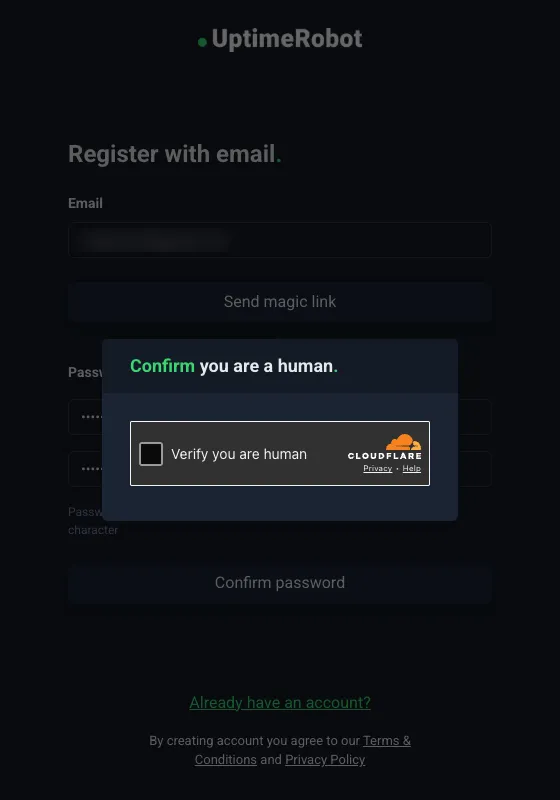
eu,us,as,au, request timeout 30 s, SSL verification on, email alerts on. These were the form defaults, apart from the 3-minute frequency. - UptimeRobot: we opened the signup page at 00:40:41 SGT (16:40:41 UTC on Sep 30) and filled the form. Submitting it opened a Cloudflare Turnstile box, "Confirm you are a human.", which did not pass by itself after more than 20 seconds. The same check appeared for the magic-link option and at login. Our rule is that the test agent never solves or bypasses captchas, so we stopped there at 00:44:11 SGT. A person in a normal browser may well pass this check; we did not test that. Every UptimeRobot fact after signup on this page comes from UptimeRobot's own pricing page, terms and help center, and is labelled that way.
Free tiers side by side
How to read the labels: observed means we saw it in our own Better Stack free account on Oct 1, 2026. official means the vendor's pricing page, terms or docs, fetched from Singapore on Oct 1, 2026. not stated means we searched the official pages and found no answer. Prices are in USD as shown from Singapore. UptimeRobot says other regions can see a different currency and different numbers.
| Item | UptimeRobot Free | Better Stack Free |
|---|---|---|
| Monitors | 50 official | 10 monitors + 10 heartbeats official; same numbers on the in-app plan screen observed |
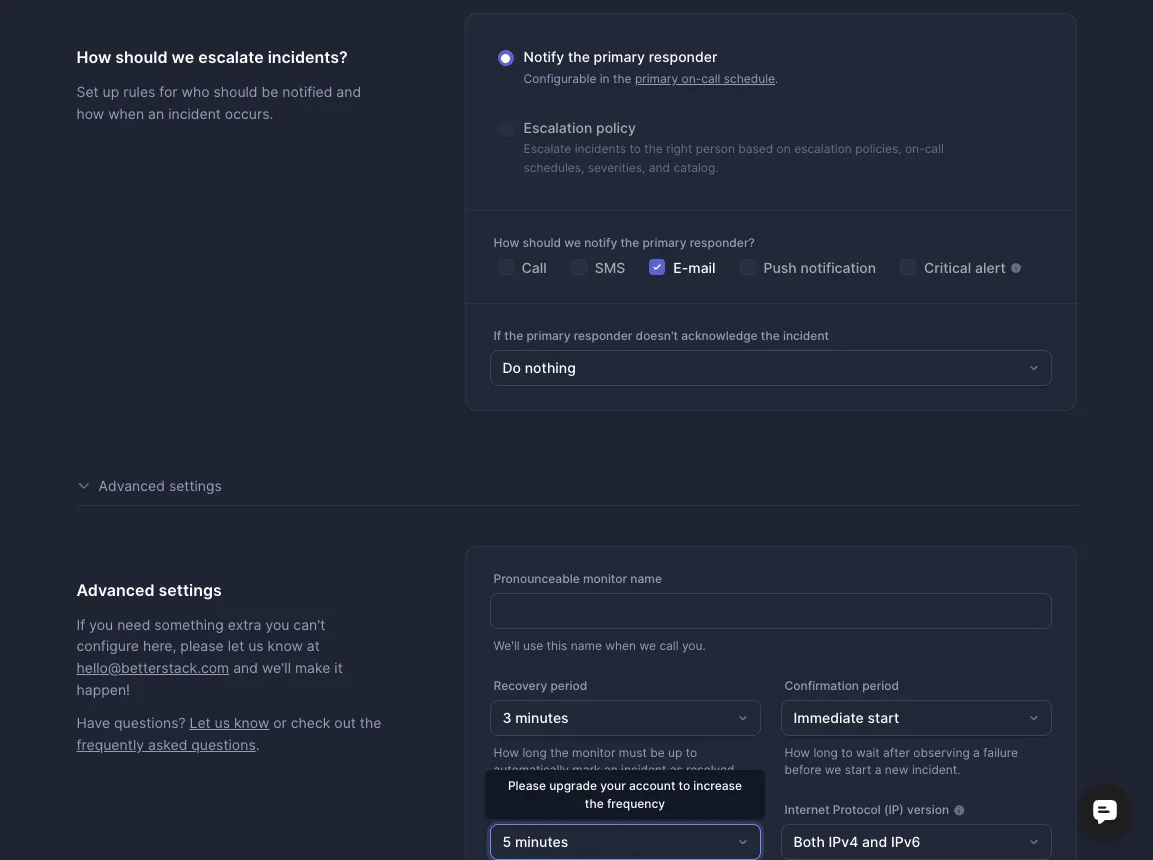
| Fastest check interval | 5 minutes official | 3 minutes. The 30 s, 45 s, 1 min and 2 min options are greyed out ("Please upgrade your account to increase the frequency"), and the first form we opened defaulted to 5 minutes observed |
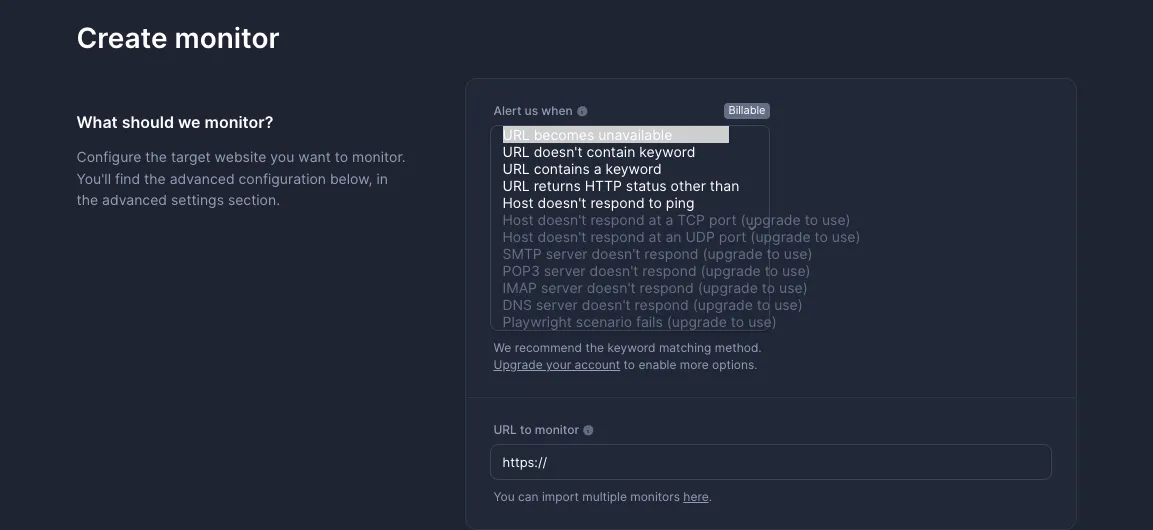
| Monitor types | HTTP(S), keyword, ping, port. API, UDP, DNS, heartbeat and SSL/domain expiry monitoring need a paid plan official | Available: URL unavailable, keyword missing or present, unexpected HTTP status, ping. Marked "(upgrade to use)": TCP, UDP, SMTP, POP3, IMAP, DNS, Playwright observed |
| Regions and outage confirmation | Choosing check locations is a paid feature; with no region chosen, monitors run from North America. A monitor goes Down after up to 3 retries in the same region, and the docs say "There's no quorum" official | Europe, North America, Asia and Australia are all ticked by default and none is locked observed. Confirmation is a waiting time (default "Immediate start"), not a count of failing locations. How many regions must agree: not stated |
| Alert channels | Email, mobile app push, Google Chat, Discord, Pushover, Pushbullet, Splunk. SMS and voice calls work but need purchased credits (none included). Slack, Teams and Telegram start at Solo; webhooks, Zapier and PagerDuty at Team official | Email: on by default. Call, SMS and push checkboxes: disabled. Outgoing webhooks, PagerDuty and email to external addresses: upgrade prompt. Discord and Telegram: not listed observed. Slack: on the plan card official, delivery not tested |
| Status page | 1 page, on an UptimeRobot URL only. No own domain, password, subscribers or custom design official | 1 page on *.betteruptime.com. Removing "Powered by Better Stack", subscribers, password and IP allowlist are marked Billable. The custom-domain field is not locked, but we did not test it observed |
| Heartbeat / cron monitors | Not on Free official | 10 included official. Our test heartbeat defaulted to expecting a ping once a day, with a 5-minute grace period observed |
| SSL / domain expiry alerts | Not on Free official | Every option shows "(upgrade to use)" observed. Docs: "Certificate expiration alerts require a paid plan" official |
| API | Included, rate-limited to 10 requests per minute official | You can create tokens on Free. A team-scoped Uptime token worked; a global token returned 401 observed. Rate limit: not stated |
| Team seats | No login seats and no notify-only seats official | 1 member. The invite form's default role is "Responder", tagged Billable observed. Whether a second free seat is possible: not stated, not tested |
| Data retention | 3 months official | not stated on the current pricing page (a January 2025 archived copy said "2-month incident history"). Status page history can be set to anything from 7 to 365 days observed |
| Maintenance windows | Paid plans only official | The field is on the free monitor form and not locked observed; we did not test whether it works |
| Commercial use | Terms: "available for any use, including commercial and business use". The pricing card still says "Good for hobby and non-profit projects" official | Pricing card: "Free for personal projects". The Terms of Use (last updated Feb 14, 2025) have no free-plan commercial clause official |
| Card at signup | "No credit card required!" official | No card asked once Free was selected observed |
| First paid step | Solo: $10/month, or $9/month billed yearly. 10 monitors, 60-second checks official | $34 per responder licence per month, or $29 billed yearly. Includes unlimited phone and SMS alerts official; same prices on our billing page observed |
Better Stack free: what happened when our site went down
We set the Worker to return 503 in four windows: two long outages, one 90-second blip, and one window that deliberately starts 47 seconds past the minute. All four windows ran on Oct 1, 2026. The table comes from our probe log and the alert emails.
| Window | Outage (SGT, UTC) | Start → first failing probe | Start → "started" email | End → first 200 probe | End → "resolved" email | Public status page |
|---|---|---|---|---|---|---|
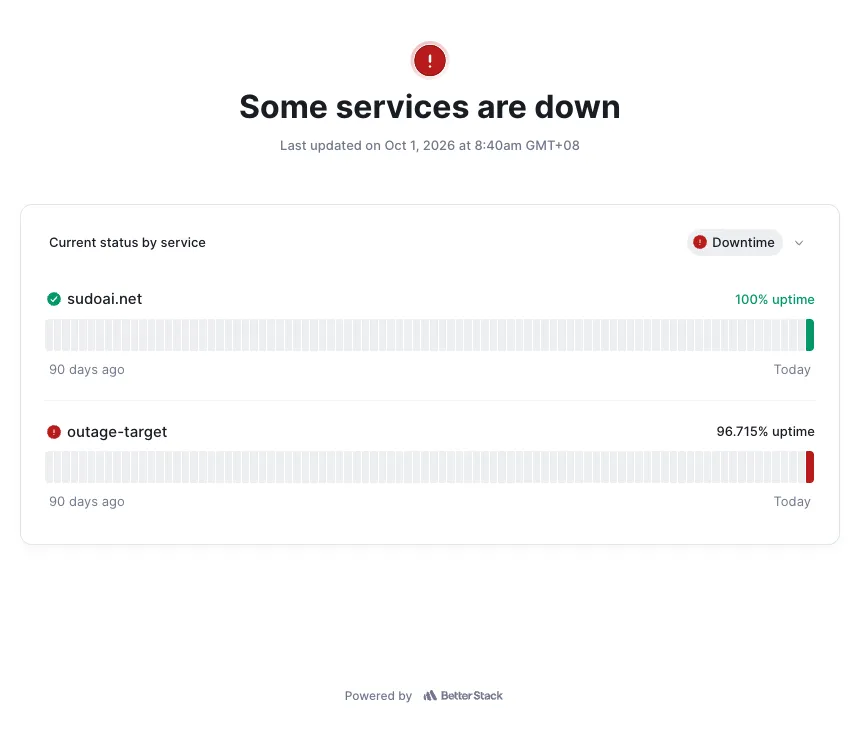
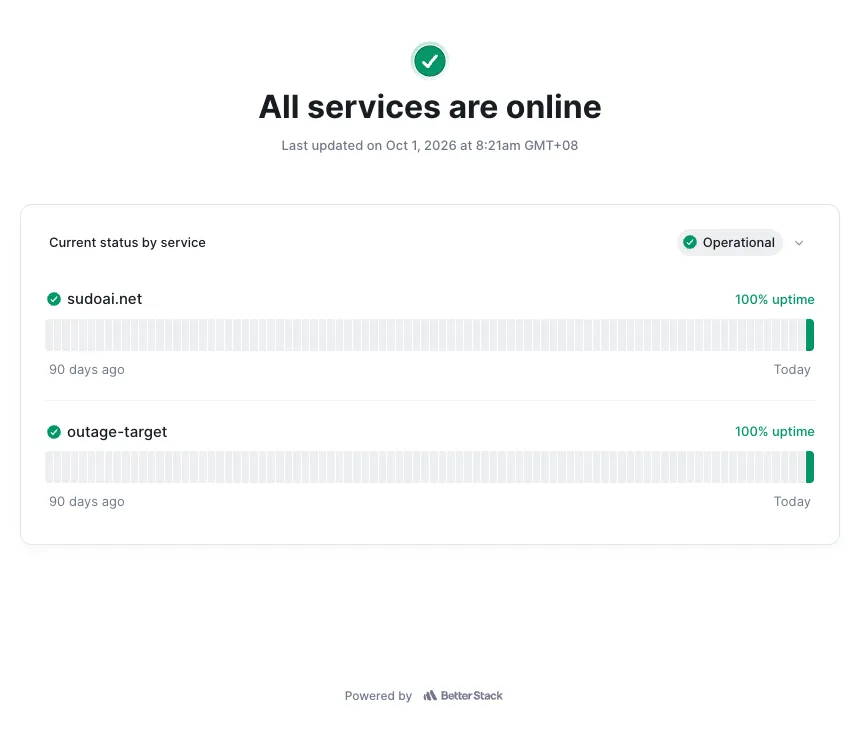
| W1 | 08:40:00–08:55:00 (00:40–00:55 UTC), 15 min | 2.954 s (Sydney) | 10 s | 33.4 s | 241 s | "Some services are down" within 47 s of the start; "All services are online" again 227–287 s after the end |
| W2 | 09:20:00–09:32:00 (01:20–01:32 UTC), 12 min | 1.841 s (Sydney) | 8 s | 10.6 s | 198 s | Down within 47 s of the start; online again 167–227 s after the end |
| W3 | 10:00:00–10:01:30 (02:00:00–02:01:30 UTC), 90 s | 5.011 s (Sydney) | 12 s | 3.9 s | 208 s | Down within 47 s of the start; online again 137–197 s after the end |
| W4 | 10:13:47–10:24:00 (02:13:47–02:24:00 UTC), 10 min 13 s, starts off the minute | 12.043 s (Ashburn) | 19 s | 2.2 s | 191 s | Not available (our status-page watcher stopped at 02:08 UTC, before W4) |
Probe times come from the Worker's clock, to the millisecond. Email times are Gmail receive times, to the second. The status page was checked about once a minute, so its change times are known only to within that minute; it was not checked during W4. The Worker, Gmail and our Mac use three different clocks, so treat differences under a second as noise.
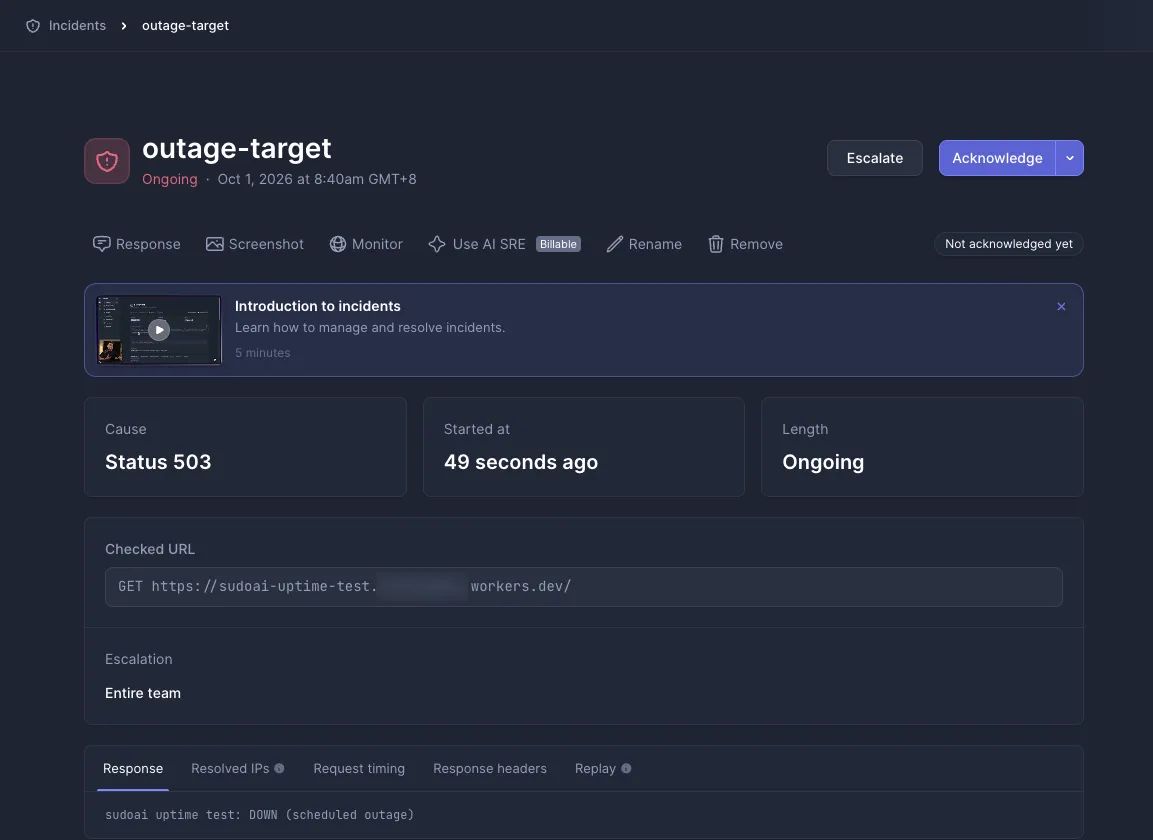
What the probe log shows
- The site is probed far more often than every 3 minutes. While the site was healthy, a probe arrived from some region every 30.3 s (median, across our quiet periods up to 10:32 SGT). The Singapore, Sydney and Europe (Germany) probes each came about every 120 s. The US probe (Ashburn) came less often and less regularly: median gap 240.5 s, longest 365.4 s. Across our quiet periods, the longest gap between any two probes was 74.5 s. This is what we saw on one monitor on one day, not a promise from Better Stack.
- Before alerting, Better Stack re-checks from other regions within seconds. In W1 the first 503 reached us from Sydney. Europe, the US and Singapore followed 3.1, 3.4 and 3.6 s later, and Singapore again at 6.4 s. W2 looked the same: Europe at +2.6 s, Singapore at +3.1 s and +5.8 s. So did W3: Europe +2.6 s, Singapore +2.9 s, the US +3.8 s, Singapore again +6.4 s. In W4 the first 503 came from the US; Sydney, Europe and Singapore followed at +2.8, +3.0 and +3.0 s, and Sydney again at +7.2 s. The email reached Gmail 7.0 s (W1), 6.2 s (W2), 7.0 s (W3) and 7.0 s (W4) after the first failing probe. So "Immediate start" still includes a fast multi-region re-check before the alert. That is our reading of the log; Better Stack does not document how many regions must agree.
- A
/favicon.icorequest came in alongside the failure. In all four windows, within 0.07 s of the last re-check 503, the same region also asked for/favicon.ico: Singapore in W1–W3, Sydney in W4. That never happened while the site was up. Our guess is that this is a browser loading the error page to take the incident screenshot. Better Stack's docs say screenshots are taken when the failing response has a body, but the request itself is not labelled. - Recovery takes about 3 minutes, by design. After the first 200, probes came roughly every 1.2–2.5 s (median; 27 in W1, 24 in W2, 36 in W3, 25 in W4) until the incident closed. The resolved email arrived 207.6 s (W1), 187.4 s (W2), 204.1 s (W3) and 188.8 s (W4) after the first successful probe. That matches the default 3-minute recovery period. The dashboard showed the monitor going Down, then "Validating recovery", then Up.
- The "Length" field reports downtime, not the full incident. The W1 resolved email said "Resolved at: 8:58am" but "Length: 15 minutes", which is the length of the outage itself. The 3-minute validation is not counted. The W2 incident showed 12 minutes, again equal to the outage, and the 90-second W3 blip showed 1 minute.
Minute-aligned windows were the lucky case; W4 was not
W1, W2 and W3 started exactly on the minute. Better Stack's probes on our monitor bunched at fixed seconds: most arrived 0–15 s or 30–45 s past the minute. So a probe landed 1.8–5.0 s after each start, close to the best possible timing, and the email followed 8–12 s after the start. W4 started at 47 s past the minute, between the clusters. Its first failing probe came 12.043 s after the start, from the US this time, and the email 19 s after the start. The re-check and email step still took about 7 s; the extra time was waiting for a probe.
W3 was only 90 seconds long, and it still opened an incident and sent both the "started" email (12 s after the start) and the "resolved" email. On our monitor, the frequent probes caught it easily.
Worst case (our reasoning, not a measurement): an outage that starts just after a probe goes unnoticed until the next one. In our log that would mean waiting up to about 75 s (the longest gap we saw), plus the 6–7 s of re-checks and email. Better Stack only promises the configured interval, though. If you plan around its numbers rather than our single day of logs, count on up to 3 minutes plus email delivery before you hear about a problem. At the nominal 3-minute interval, a 90-second blip like W3 could in principle fall entirely between two checks.
What the alert email contains
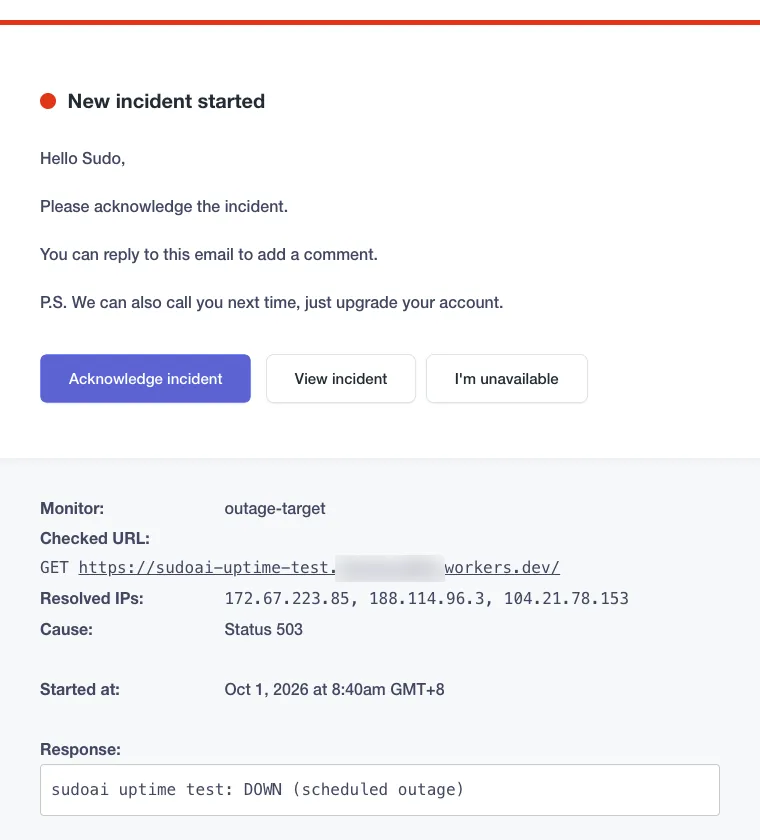
The "New incident started" email came from [email protected]. The subject is the monitor name plus the start time, for example "outage-target - Oct 1, 2026 at 8:40am GMT+8". The body contains:
- The monitor name, the method and URL that were checked, the resolved IP addresses, the cause ("Status 503"), the start time, and the response body.
- "Acknowledge incident", "View incident" and "I'm unavailable" buttons, plus a note that you can reply to the email to add a comment.
- An upsell line: "P.S. We can also call you next time, just upgrade your account."
The resolved email lands in the same Gmail thread. It adds "Resolved at" (marked automatic) and "Length". One caution: the Acknowledge, View and "I'm unavailable" links each carry a Better Stack magic-link sign-in token. We did not test whether opening one signs in a different browser. Until you know, think twice before forwarding these emails to a shared inbox or a ticket system.
Setup: what signing up was like
Better Stack (completed on Free)
Our automated run took about 7 min 58 s of active time from the signup page to the second saved monitor, plus a 3 min 50 s wait for the first sign-in email. A person clicking by hand would take a different amount of time.
- Email only. The signup form asks for a work email and sends a magic link (1 field, 1 click). There is no password, and no captcha appeared. You also sign in by magic link every time; the account has no password login.
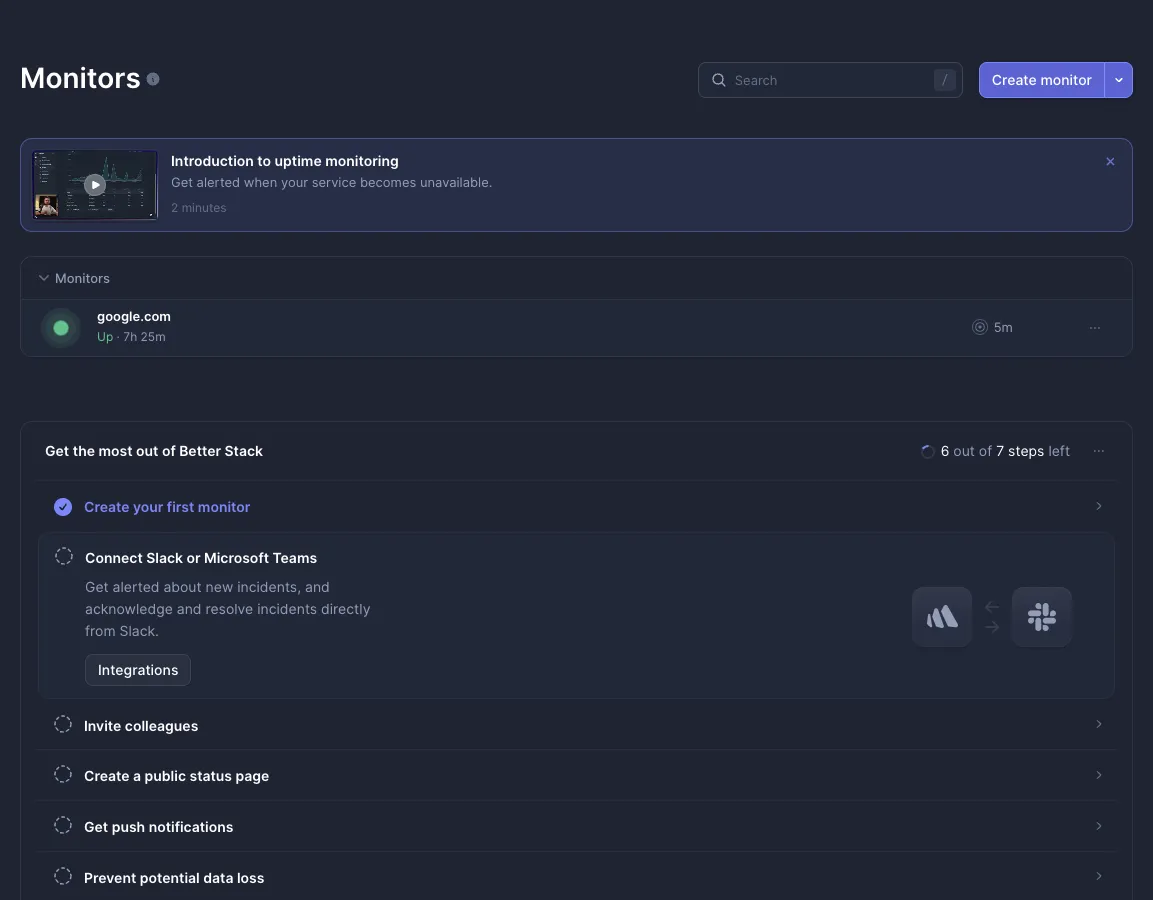
- Six onboarding screens. The first requires six fields: first name, last name, company, company size, role, and where you heard about Better Stack. Then come screens for use cases, integrations, a "Where can we call you" phone screen (skip it with "Continue without a test call"), theme and invites.
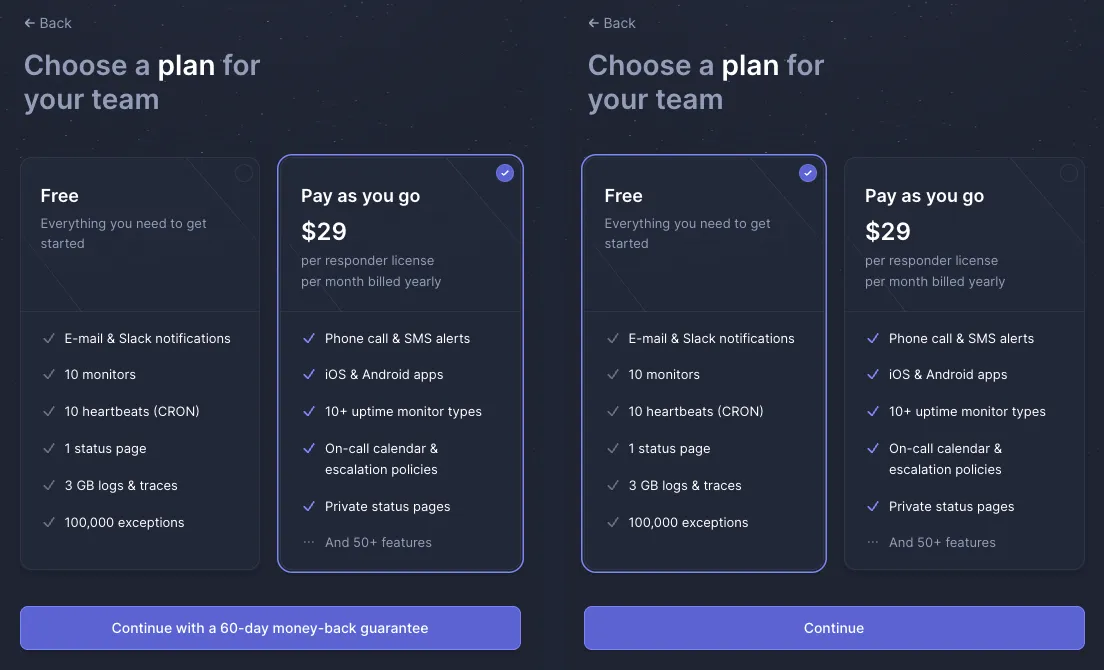
- The plan screen pre-selects the paid plan. This is the biggest gotcha. "Pay as you go, $29 per responder license" is ticked when the page loads, and the button reads "Continue with a 60-day money-back guarantee". Click the Free card first, and the button changes to "Continue". After we chose Free, no card form appeared.
- A sample monitor and a sample incident. The dashboard already contained a
google.commonitor we never created, plus an ongoing, unacknowledged "Sample incident" on it. The new status page was also pre-filled with that google.com monitor. Delete both before you rely on your incident count. - A request for a backup card on a cardless Free account. The onboarding checklist included "Prevent potential data loss: Your account is at risk of losing data if your next transaction is declined", with an "Enter a credit card" button and a free t-shirt offer. We had no card on file, so there was no transaction to decline. We ignored it.
- No friendly-name field. The only name field is "Pronounceable monitor name" ("We'll use this name when we call you"), under Advanced settings. Fill it in, or your monitor list shows raw URLs. Monitor A took 3 fields and 3 clicks.
- API tokens. A global API token returned
401 "Invalid Team API token"on the Uptime API; a team-scoped Uptime token worked. If your script gets a 401, use a team token.
UptimeRobot (signup only)
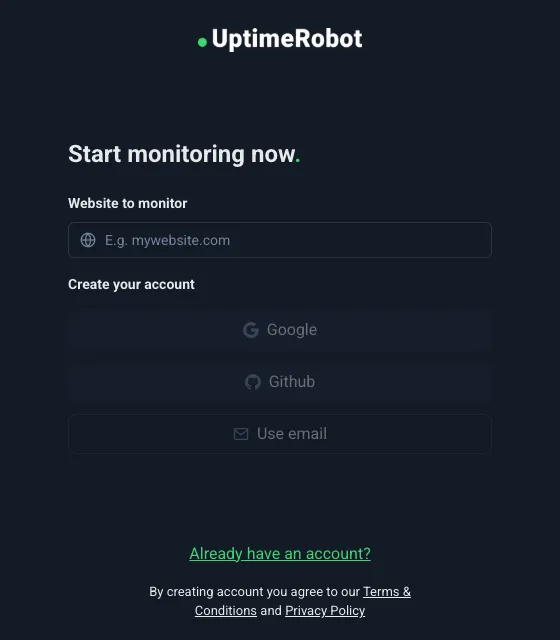
- It asks for the website first. The signup page opens with one field, "Website to monitor". The Google, GitHub and "Use email" buttons stay disabled until you enter a URL. No name, company or team-size questions were shown.
- Magic link or password. Passwords must have "8 characters, 1 number, a capital letter and 1 special character".
- A Turnstile check on every route in. Submitting the password form, requesting a magic link, and logging in each opened "Confirm you are a human." In our automated Chrome, it had not passed after more than 20 seconds. UptimeRobot sent no email before this check, so we never got as far as an account. From opening the page to our stop took 3 min 30 s, with 3 clicks and 4 fields.
Status pages compared
UptimeRobot Free (official pricing page and terms): 1 status page, "with a unique UptimeRobot URL only". You cannot use your own domain, add a password or subscribers, customize the design, translate it, white-label it or hide it from search engines. A password, white-label and subscribers all need the Team plan ($41/month, or $35/month billed yearly).
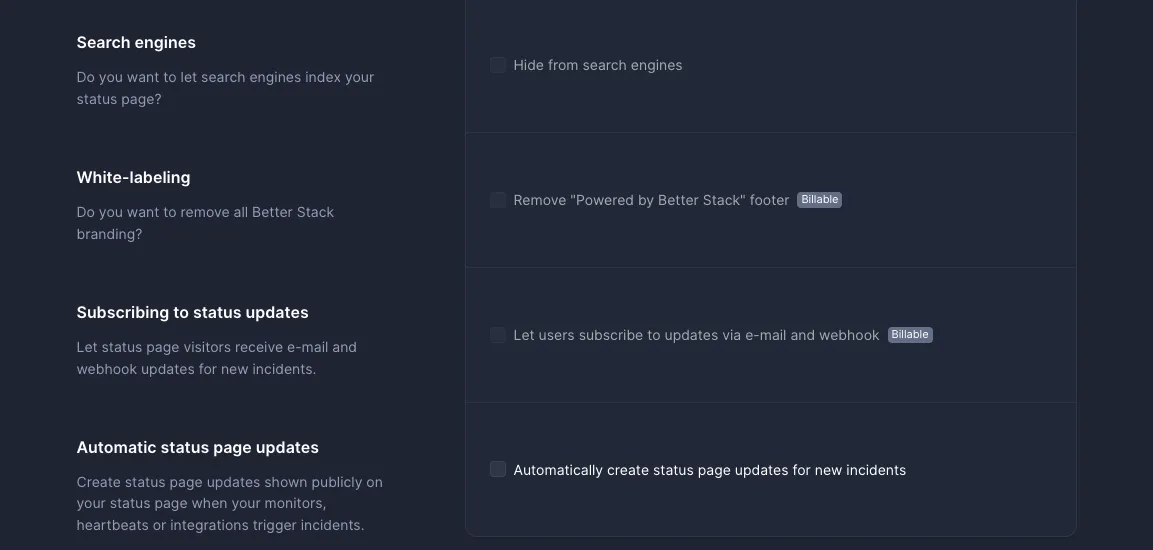
Better Stack Free (what our account showed): 1 status page on *.betteruptime.com. Ours loaded logged out (HTTP 200), and in all three test windows our watcher covered (W1–W3) it switched to "Some services are down" within a minute of the outage starting. Logo, light or dark theme, layout, favicon, announcements, the embed iframe and badge, and the history length (7 to 365 days, default 90) are all available. These are marked Billable: removing the "Powered by Better Stack" footer (listed at $250 per page per month, or $208 billed yearly), email and webhook subscribers, a password ($50 per page per month, or $42), IP allowlist, SSO, and custom CSS/JS. "Hide from search engines" and the Google Analytics tag field are disabled. One small trap: after we saved the page, its structure already listed the sample google.com monitor.
Gotchas from the docs
UptimeRobot (from its help center; not tested by us)
- One region, no quorum. Connection failures are retried up to 3 times, 20 s apart; application errors up to 3 times, 10 s apart. Then "a single region's failed (and retried) check is enough to mark the monitor down." SSL errors are not retried at all.
- HEAD by default. HTTP monitors send HEAD and switch to GET only on a retry, and some servers reject HEAD with 403, 404 or 405. Any 2xx or 3xx response counts as up.
- Keyword monitors work the opposite way you might expect: "If the condition selected is true, the monitor status goes to 'down'".
- Downgrading pauses everything. If you are over the new limit, "all of your monitors are paused — not just the monitors above the limit." SSL and domain reminders switched off by a downgrade are not switched back on when you upgrade again.
- Six months without logging in deactivates the account. Logging back in does not resume your monitors automatically.
- Status page subscribers (paid) only get announcements. "Monitor downtime and recovery are never emailed to subscribers automatically."
- Monthly email reports on Free stop after the first 3 months.
Better Stack (docs, plus what we saw)
- Confirmation and recovery are measured in time, not checks. The confirmation period is how long Better Stack waits after a failure before opening an incident. One failed check during the recovery period restarts the recovery timer.
- The timeout must not exceed the check frequency, "as this would cause an error". The default timeout is 30 s.
- Keyword matching is case-insensitive.
- No screenshot on timeouts. Error screenshots are only taken when the failing response has a body.
- Firewall allowlists: Better Stack's probe "IPs will change without prior notice". It suggests allowlisting by User-Agent instead. On our Worker, that was
Better Stack Better Uptime Botfollowed by a Chrome 130 string. - Incident grouping can keep a critical incident silent when it is grouped with another one, according to the docs.
- Paid monitor types have no lock icon in the "Create monitor" dropdown next to the button; clicking one just redirects to billing. The form itself does mark them "(upgrade to use)".
Pricing and terms history that matters
| When | What changed | Evidence |
|---|---|---|
| Nov 2024 | UptimeRobot limits the free plan to "personal, non-commercial use". The clause bans, for example, monitoring business websites and putting uptime data in client reports. | The clause appears in Internet Archive captures of the terms between Nov 4 and Nov 13, 2024 (UTC). HN users quoted an email saying it applied "From 1st November 2024". It is not listed in the terms changelog. |
| By Jan 2025 | Better Stack's free log allowance drops from 50 GB kept for 7 days to 3 GB kept for 3 days. | Archived pricing pages from Jun 25, 2024 and Jan 7, 2025 |
| By Oct 2025 | Better Stack's free card is relabelled "Free for personal projects". | Archived pricing page, Oct 5, 2025 |
| May–Jun 2026 | UptimeRobot drops the commercial-use ban and adds a Fair Use Policy. | The terms changelog entry is dated May 26, 2026. A Jun 5, 2026 capture still has the ban; the Jun 21, 2026 capture has the new wording. |
| By Jun 28, 2026 | UptimeRobot raises prices. Solo goes from $8 to $10 a month ($7 to $9 billed yearly), and Team from $34 to $38 ($29 to $33). | Archived pricing pages |
| Oct 1, 2026 | UptimeRobot Team is now $41 ($35 yearly) with 30-second checks. A new Scale tier starts at $77 ($65 yearly). | Live pricing page |
| Jun 2024 → Oct 2026 | Better Stack's responder licence has stayed at $34 a month ($29 billed yearly). | Archived page from Jun 25, 2024 and the live page |
If you are choosing a free plan to rely on for years, this history matters more than any single feature. UptimeRobot changed its free-plan terms twice in about 19 months. Better Stack has kept the same free monitor limits (10 monitors, 3-minute checks) since at least 2022, when it was still called Better Uptime, while trimming its free log allowance and now labelling Free as being for personal projects.
What users say
These are user reports, not our findings. We could only collect them from Hacker News and Trustpilot. Reddit, G2, Capterra and TrustRadius blocked our automated requests, so nothing from those sites is included. The sample is small and skewed towards HN, so use it to spot themes, not to score the products.
- Ratings on Trustpilot (Oct 1, 2026): UptimeRobot 4.7 out of 5 from 477 reviews. Better Stack 4.0 from 3 reviews, which is too few to mean much.
- UptimeRobot, 17 reports: 7 are about the 2024 commercial-use ban, and all date from Oct–Nov 2024, before the reversal. One user called it a "fake free plan" (HN, Nov 26, 2024). Another wrote that the change "somehow already took effect on November 1" (HN, Nov 26, 2024). On the positive side, 4 praise alert speed or reliability and 4 praise easy setup; one long-time user wrote "relatively happy" (HN, May 2024). One reports a false positive (HN, Nov 2024). One Trustpilot reviewer says SMS alerts never reached their phones.
- Better Stack, 12 reports: 2 praise heartbeats, for example "I do like BetterStack heartbeats" (HN, Jan 2025). 2 praise reliability and 2 praise easy setup. 4 mention outages or incidents at Better Stack itself, each a single post: status pages showing other customers' pages in Oct 2023 (HN), "Betterstack Is Down" in Dec 2024 (HN), and the Nov 18, 2025 Cloudflare outage. During that outage, one user could not log in to Better Stack or UptimeRobot but kept receiving down alerts (HN). One paid customer reports cutting monitoring and alerting costs by 90% after switching from Datadog and PagerDuty (HN, Jun 2025).
Decision table
| Pick if you… | Fits this use case | Why |
|---|---|---|
| have 11–50 small sites or endpoints and 5-minute checks are enough | UptimeRobot Free | 50 monitors against Better Stack's 10. Commercial use is allowed in the current terms. The API is included at 10 requests per minute. |
| work in Slack, have up to 10 critical endpoints, and run cron jobs or backups | Better Stack Free | 10 monitors with 3-minute checks from 4 regions, 10 heartbeats, and Slack plus email. In our four test outages, alerts arrived 8–12 s after the start for minute-aligned outages and 19 s for the off-minute one. |
| only need to watch cron jobs | Better Stack Free or Healthchecks.io | Better Stack includes 10 heartbeats. Healthchecks.io's free Hobbyist plan covers 20 jobs. UptimeRobot Free has no heartbeats. |
| need SSL or domain expiry alerts at $0 | Neither: try StatusCake | Paid on both. StatusCake's free plan lists 10 uptime monitors at 5-minute intervals, 1 SSL monitor and 1 domain monitor. |
| need 1-minute checks at $0 | Neither: try HetrixTools | HetrixTools lists checks "every minute on every plan", with 15 free uptime monitors from 4 of its 12 locations. You must log in every 90 days. |
| need browser or Playwright checks at $0 | Neither: try Checkly or Grafana Cloud | Playwright monitors are paid in our Better Stack account, and UptimeRobot has no browser checks. Checkly Hobby lists 1,000 browser checks, 10 uptime monitors and 2-minute checks. Grafana Cloud's free tier allows 10k browser test runs a month. |
| want phone calls or an on-call rotation | Neither free plan | Better Stack needs a responder licence ($29–34 a month). UptimeRobot Free can make calls only with purchased credits (10 credits for $3; one call uses 2 credits) and has no on-call product. |
| want unlimited monitors and no vendor terms to worry about | Neither: self-host Uptime Kuma | MIT-licensed, about 92k GitHub stars. You then have to keep the monitor itself running. |
Freshping is not on this list because third-party sources say it shut down on March 6, 2026. We could not confirm that on Freshworks' own site, which blocked our requests. For more monitoring and automation write-ups, see Run: monitoring and automation picks.
Sources
Official pages, all fetched from Singapore on October 1, 2026 (SGT):
- UptimeRobot pricing (00:35) and pricing.md (00:36)
- UptimeRobot terms (00:35) and Fair Use Policy (00:37)
- UptimeRobot: who should use the free plan (00:37)
- UptimeRobot: debugging a monitor showing as down (00:37)
- UptimeRobot: what happens when you downgrade (00:37)
- UptimeRobot: status page subscribers (00:37)
- UptimeRobot: account deletion and inactivity (08:18)
- UptimeRobot API v3 (08:18)
- Better Stack pricing (00:35) and status page product page (08:09)
- Better Stack Terms of Use (00:35)
- Better Stack docs: check frequency (00:39), SSL certificate monitor (00:39), confirmation and recovery period (08:18), request timeout (08:08), keyword monitor (08:08), incident details (00:39), FAQ (00:39)
- Alternatives' pricing pages: Healthchecks.io, StatusCake, HetrixTools and Checkly (00:47), Grafana (00:47), Uptime Kuma GitHub API (08:17)
- Pricing and terms history: Internet Archive snapshots of the UptimeRobot terms and pricing pages and the Better Stack pricing page, fetched between 00:42 and 08:11
Our own test data (probe log, outage results, emails, timelines) was recorded the same day, starting at 00:40 SGT.
Who should not use this
Skip Better Stack Free if:
- You need more than 10 HTTP monitors. Extra monitors are sold as an add-on ($25 a month for 50 more, or $21 billed yearly).
- You need SSL or domain expiry alerts, or TCP, UDP, DNS or SMTP checks. All of them showed "(upgrade to use)" in our free account.
- You want phone or SMS alerts, an on-call rotation or escalation policies. Those need a responder licence at $29–34 a month.
- Your use is clearly commercial, and the "Free for personal projects" label on the pricing card worries you. The terms themselves say nothing either way.
- You need to send alerts to a webhook or an outside email address. Both showed an upgrade prompt.
Skip UptimeRobot Free if:
- Your team works in Slack or Teams, or your alerts need to reach a webhook. Free supports none of these.
- You need to watch cron jobs or backups. Heartbeat monitors start on Solo.
- One region's failed retries is too thin a basis for waking you up. Free has no multi-location confirmation.
- You need your status page on your own domain, or more than one login on the account.
- You might not log in for 6 months, for example on a side project you leave alone. The account gets deactivated, and your monitors stay paused after you log back in.
Frequently asked questions
Is UptimeRobot free for commercial use in 2026?
Yes, according to the current terms: "UptimeRobot is available for any use, including commercial and business use." The free plan was restricted to personal, non-commercial use from November 2024; the terms changelog dates the reversal May 26, 2026, and an Internet Archive capture from June 21, 2026 shows the new wording. The pricing card still describes Free as "Good for hobby and non-profit projects" (checked Oct 1, 2026).
How fast does Better Stack free alert when a site goes down?
In our four test outages on Oct 1, 2026, the alert email reached Gmail 10 s, 8 s, 12 s and 19 s after the site started returning 503. The first three began exactly on a minute boundary, close to a scheduled probe, and took 8–12 s. The fourth started 47 s past the minute, between probe clusters, and took 19 s. The monitor was set to 3-minute checks, the shortest interval on the free plan.
Does Better Stack free include SSL certificate expiry alerts?
No. Better Stack's docs say "Certificate expiration alerts require a paid plan", and in our free account every SSL and domain expiration option on the monitor form was greyed out with "(upgrade to use)". UptimeRobot Free does not include SSL or domain expiry monitoring either.
How many monitors do the free plans include?
UptimeRobot Free: 50 monitors at a 5-minute interval. Better Stack Free: 10 monitors at a 3-minute interval, plus 10 heartbeat (cron) monitors. Both figures are from the official pricing pages, checked Oct 1, 2026; Better Stack's numbers also appeared on its in-app plan screen.
Does either free plan include Slack alerts?
Better Stack Free lists "E-mail & Slack notifications" on its plan screen; we did not connect Slack, so delivery is not tested. UptimeRobot Free does not include Slack: Slack, Mattermost, Telegram and Microsoft Teams start on the paid Solo plan.
Can I use a custom domain on a free status page?
UptimeRobot: no. The free plan gets one status page on an UptimeRobot URL; your own domain starts on Solo. Better Stack: its status-page product page advertises a free status page "on your subdomain", and the custom domain field was not locked in our free account, but we did not configure a domain, so this is not verified.
Does Better Stack ask for a credit card on the free plan?
Not in our signup. But the plan screen pre-selects the paid "Pay as you go" plan ($29 per responder licence per month, billed yearly), and the main button reads "Continue with a 60-day money-back guarantee". You have to click the Free card first. After we chose Free, no card form appeared, although the dashboard later suggested adding a backup card.